Dourada ao Sal
Whole gilt-head bream baked inside a sealed salt crust, finished at the table with olive oil and flor de sal
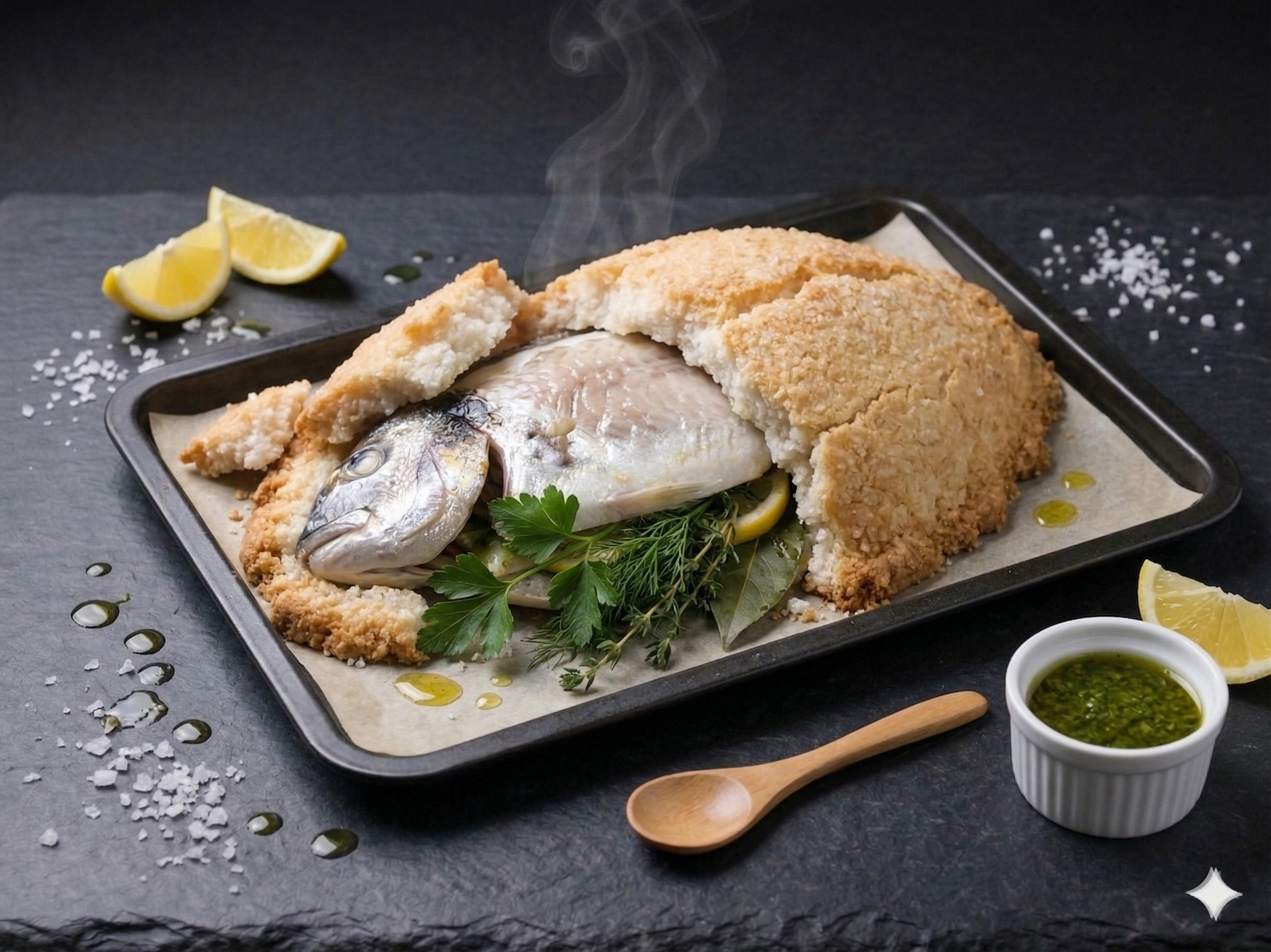
Yield: 4 portions
Portion: ~half fillet per person (from 1kg fish)
Prep: 20m
Cook: 25m
Rest: 5m
Total: 50m
Ingredients
Fish
- 1 kg whole gilt-head bream (dourada), gutted but NOT scaled — scales are essential as a salt barrier; brought to room temperature 1.5–2 hours before cooking
Salt crust
- 2 kg coarse sea salt (sal grosso), use good quality sea salt for the bottom third; cheaper coarse salt is fine for the top
- 3 pieces egg whites, 3–4 whites; binds the salt into a moldable crust
- 2 tbsp water, combined with egg whites to adjust consistency
Cavity aromatics
- 1 unwaxed lemon, sliced into 3–4mm rounds; must be unwaxed — heated wax releases off-flavors
- 4 sprigs fresh thyme, whole sprigs — do not chop
- 2 pieces bay leaves, fresh or dried
- 1 generous handful flat-leaf parsley, whole sprigs, stems included — do not chop
- 1 small bunch fresh dill, whole fronds
- 6 fronds fennel fronds, 6–8 fronds(optional)
- 2 cloves garlic, 2–3 cloves, thinly sliced 2mm — not minced; you want aromatic steam, not garlic paste
- 2 tsp extra-virgin olive oil, for the cavity interior
- 0 to taste freshly ground white pepper, a few grinds
- 1 tbsp dry white wine or dry vermouth, 1–2 tbsp; creates perfumed steam inside the crust(optional)
Finishing (at the table)
- 0 to taste best-quality extra-virgin olive oil, your best bottle — it is the primary condiment
- 0 to taste flor de sal, Portuguese (Tavira or Castro Marim) or Maldon; do not substitute iodized table salt
- 1 lemon fresh lemon wedges, cut into wedges for serving
Method
Temper and prepare
- 1
Remove the fish from the fridge 1.5–2 hours before cooking. Place on a tray lined with paper towels, loosely covered. A room-temperature fish cooks evenly; a fridge-cold one overcooks the exterior before the center reaches temperature.
2hTip: This is the single most important preparation step. Skipping tempering is the most common cause of overcooked outer flesh and underdone center in salt-baked fish.
- 2
Preheat oven to 220°C (conventional, not fan) — start 30 minutes before you plan to cook. Line a rimmed half-sheet baking tray with parchment paper. Warm serving plates in the oven at 60–70°C, or stack them on top of the preheating oven.
30m - 3
Slice the lemon into 3–4mm rounds. Slice 2–3 cloves of garlic into 2mm slices (not minced). Assemble the herb bundle: 4 sprigs thyme, 2 bay leaves, a generous handful of flat-leaf parsley (whole sprigs), a small bunch of dill, and fennel fronds if available. Keep everything as whole sprigs — chopping releases oils prematurely.
10m - 4
Mix the salt crust: in a large bowl, combine 2kg coarse salt with 3–4 egg whites and 2 tablespoons water. Mix with your hands until the mixture resembles damp beach sand — a squeezed fistful should hold its shape but not drip. If it's too dry, add water one teaspoon at a time.
5mSalt-Crust BakingTip: The egg white–to–salt ratio determines whether your crust will be a clean, crackable dome or a crumbly mess. Aim for 'damp sand that holds when squeezed' — that is the correct consistency.
Build the salt dome
- 5
Pat the exterior of the tempered fish completely dry with paper towels — moisture on the skin will dissolve the crust unevenly. Season the cavity lightly with white pepper (a few grinds). Drizzle 2 teaspoons of EVOO inside the cavity. Layer the aromatics: lemon slices first (lining the cavity wall), then garlic slices distributed among them, then the herb bundle laid along the length of the fish — thyme, bay leaves, parsley, dill, fennel fronds. If using wine or vermouth, splash it in now.
5mTip: White wine or vermouth seems like a minor addition, but alcohol volatilizes aromatic compounds that water alone won't carry — the steam inside the sealed crust will be noticeably more perfumed.
- 6
Spread roughly one-third of the salt mixture on the prepared tray in an oval bed about 1.5cm thick and slightly larger than the fish's footprint. Lay the fish centrally on this bed. If using a probe thermometer — and you should — insert the probe through the mouth, angling it into the thickest part of the flesh (behind the head, just above the spine). Route the cable out past the tail.
3mThe probe thermometer is your most important tool for this recipe. There is no visual cue through 2kg of salt that will tell you whether the fish is at 55°C (perfect) or 65°C (overcooked). Buy one if you don't have one.
- 7
Pack the remaining two-thirds of the salt mixture over and around the fish, building an even dome about 1.5–2cm thick. Press firmly with your palms and fingers to create a cohesive shell. Seal carefully around the head, tail, and dorsal fin — these are where gaps most commonly form. The tail fin can poke through; just pack salt tightly around its base. Run your hands over the completed dome — if you can feel the fish's body outline pressing through, add more salt to those thin spots.
5mGaps in the crust let steam escape and break the sealed-environment effect — the fish will dry out rather than steam-baste in its own juices. Pay special attention to the seam where the bottom salt bed meets the top dome.
Salt-Crust Baking
Bake
- 8
Place the tray in the center of the oven. Set your probe thermometer alarm to 50–52°C internal. For a 1kg fish, this will take approximately 20–25 minutes. Do not open the oven to check — every opening drops oven temperature by 10–15°C and slows the crust hardening.
25mPull the fish at 50–52°C internal, not later. Carryover heat inside the sealed crust will bring it to the ideal final temperature of 55–58°C during the 5-minute rest. If working without a probe, pull at the 22-minute mark for a 1kg fish in a properly preheated oven.
Salt-Crust Baking
Rest, crack, and fillet
- 9
When the probe reads 50–52°C, remove the tray from the oven. Rest for exactly 5 minutes on a heatproof surface — the carryover cooking inside the sealed crust will bring the fish to its ideal final temperature of 55–58°C. This rest also allows the juices to redistribute.
5mTip: The sealed crust acts as an insulated chamber. Unlike an uncovered roast where carryover is modest, this fish will gain 3–6°C during the 5-minute rest. This is planned and accounted for in the pull temperature.
- 10
To crack: strike the top of the crust firmly along its centerline with the spine of a heavy knife or the back of a large spoon. You should hear a hollow crack. Insert a fork into the fissure and lever upward — the top half of the salt dome should lift away in one or two large pieces, taking the skin with it. If the skin doesn't come away with the crust, peel it off gently. Brush any clinging salt granules off the exposed flesh with a dry pastry brush.
2mTip: Crack the crust at the table if possible — the moment the dome breaks and releases a burst of herb-scented steam is one of the great moments in Portuguese home cooking. It is designed to be witnessed.
- 11
Using a thin fish spatula, slide along the lateral line from head to tail, angling slightly downward to ride along the spine. Lift the top fillet away in one piece and transfer to a warm plate. Grip the tail of the exposed skeleton and lift it away from the bottom fillet — it should peel off cleanly in one piece with all the ribs attached. Check for stray pin bones, then slide the spatula under the bottom fillet (separating it from the salt bed) and transfer to the second plate.
3mWhole Fish Filleting & Tableside ServiceTip: The salt-crust method produces a fish that is exceptionally easy to fillet — the flesh is set firmly but remains moist and cohesive. The skeleton almost always lifts clean.
- 12
Finish each portion immediately: a generous drizzle of your best EVOO, a pinch of flor de sal, and a lemon wedge alongside. If you've made molho verde, spoon a tablespoon alongside — not over — the fish. Serve the moment it's plated; the fish will not improve with waiting.
2mTip: The finishing EVOO is not optional — it is the primary sauce. Use your best bottle. The fish's flavor is clean and restrained; the quality of the oil is immediately perceptible.
Allergens
Storage & Shelf Life
Refrigerated
Temperature: 0-4°C
Shelf life: 1 day
Freeze: Not recommended
Salt-baked fish is best eaten immediately after cracking. If reheating leftover fillets, warm very gently in a covered pan over low heat with a tiny splash of water — 2–3 minutes maximum. Avoid microwaving, which toughens the flesh. Plan to serve the whole fish at the meal it is cooked for.
Plating
Bring the whole tray to the table before cracking — the unveiling is part of the experience. Plate individual portions onto warm plates after filleting: each fillet should be glistening, moist, and unbroken. Finish at the moment of plating with EVOO and flor de sal.
Garnish: Flor de sal, lemon wedge, molho verde alongside (optional)
Serve in: Salt-crust tray for the table unveiling; warm individual plates for portions
Temperature: Hot — serve immediately after filleting
Techniques Used
The Story Behind This Dish
“Dourada ao Sal is one of the defining preparations of the Portuguese coastal table — a technique that predates modern ovens and descends from a time when burying fish in salt was the most reliable way to cook it slowly, evenly, and without losing the precious moisture that lean fish so easily sacrifices to dry heat. The salt dome is not a gimmick. It creates a sealed, humidity-saturated chamber in which the fish steams in its own juices, surrounded by herb-scented vapor that carries aromatic compounds the flesh absorbs as it cooks. The salt itself imparts almost nothing directly — the skin and scales are a barrier — but it creates the environment. What emerges from the cracked dome is a fish cooked to exactly the temperature the technique demands: 55–58°C, silky and just set, with clean mineral sweetness that no pan-cooked fish can replicate. In the Algarve, this is a dish for occasions — a whole dourada brought to the table, cracked with ceremony, paired with batatas a murro and a pool of molho verde. The technique requires patience and a probe thermometer, but almost no active skill. It is one of those recipes where doing less produces a better result than doing more.”
Wine pairing: Alvarinho (Vinho Verde), Arinto dos Açores, or a full-bodied Douro Branco — something with mineral backbone and citrus brightness to match the clean sweetness of the fish. Avoid heavily oaked whites.
Disclaimer: The information provided in this recipe, including preparation methods, storage guidelines, and shelf-life recommendations, is for general guidance only. We accept no responsibility for any foodborne illness or adverse effects resulting from the preparation, handling, storage, or consumption of food made using this recipe. Always follow safe food handling practices and consult official food safety guidelines.
Goes well with
Comments are not configured yet.