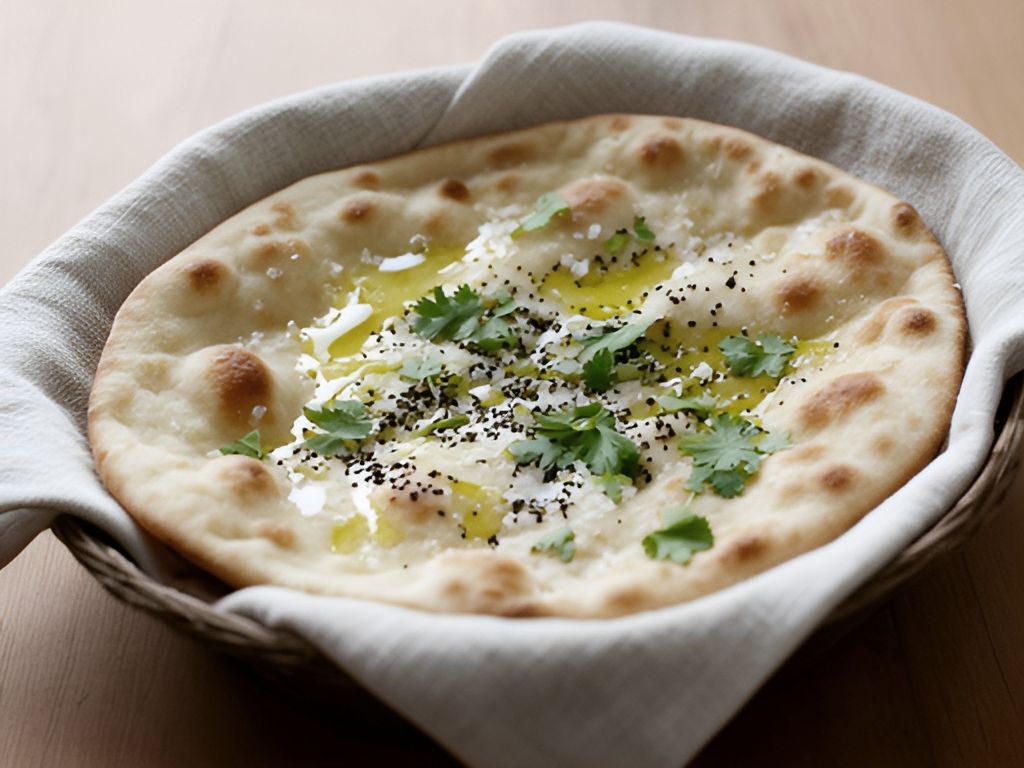
Garlic Naan
Cold-fermented overnight, cooked dry on ripping-hot cast iron and finished under the grill, with the garlic on the surface instead of burning in the crumb
Yield: 8 naan
Portion: ~85g dough per naan
Prep: 40m
Cook: 20m
Rest: 18h
Total: 19h
Ingredients
Yeast starter
- 60 ml water, warmed to 38°C
- 8 g sugar
- 5 g instant or active dry yeast
Dough
- 150 ml whole milk, lukewarm, 32-38°C
- 180 g full-fat plain yogurt, out of the fridge to lose its chill
- 1 egg yolk, at room temperature
- 50 g ghee, melted and cooled to lukewarm. Bratbutter works if you have no ghee
- 550 g Zopfmehl, or Italian Tipo 0 or German Type 550; not Ruchmehl. Up to 40g extra for kneading only if needed
- 9 g fine salt
- 5 g baking powder
- 1 tsp neutral oil, for the bowl and the tray
Garlic ghee and topping
- 80 g butter or ghee, for brushing
- 4 cloves garlic, pressed or very finely minced, for the ghee
- 2 tbsp coriander, finely chopped, for the ghee
- 2 cloves garlic, finely minced, to press into the surface
- 1 tbsp coriander, finely chopped, to press into the surface
- 1 tsp nigella seeds, a pinch per naan. Sesame seeds, or simply omit(optional)
- flaky salt, to taste
Mini blue cheese naan (optional amuse-bouche variation)
- 145 g gorgonzola dolce or Gorgonzola Cremini, 12 balls of 12g, frozen 20 minutes. Cambozola is the best fallback. Fills 12 mini naan made from 300g of the dough above, which then gives 8 dinner naan alongside(optional)
- 30 g ghee, melted, for brushing. Plain, not the garlic ghee(optional)
Method
Mix and knead (the day before)
- 1
Whisk the 8 g sugar and 5 g yeast into the 60 ml water at 38°C. Leave 10 minutes until foamy and visibly risen on top.
10m38°CThe comfortable range is 35-43°C. Yeast starts taking damage from about 50°C and dies around 55°C, so there is margin above 38. Without a thermometer: water that feels neutral to barely warm on the inside of your wrist is right; water that feels properly hot is too hot. If the mixture is still flat after 10 minutes the yeast is dead or old. Start this step again rather than carrying on.
- 2
While it foams, melt the 50 g ghee and let it cool to lukewarm. Warm the 150 ml milk to 32-38°C, about 30 seconds in the microwave. Have the 180 g yogurt and 1 egg yolk out of the fridge.
5mThe ghee is where yeast actually dies in this dough, not the water. Ghee comes off the heat well above 60°C and goes into the same bowl as the bloomed yeast. Let it cool until you can hold a finger in it comfortably, below about 45°C.
Tip: Fridge-cold milk still works. Give the dough 90 minutes on the counter instead of 45 before it goes into the fridge.
- 3
Whisk the 550 g Zopfmehl, 9 g fine salt and 5 g baking powder together in a large bowl. In a second bowl, whisk the foamed yeast with the 150 ml milk, 180 g yogurt, the egg yolk and the 50 g cooled ghee until smooth. Pour the wet into the dry and mix until it comes together as a shaggy mass.
3mTip: The egg yolk is there for its lecithin. It spreads the fat through the dough more evenly, which gives a softer crumb that stays pliable as the naan cool. That matters when eight naan are held for twenty minutes rather than eaten straight off the pan.
- 4
Knead 8-10 minutes in a stand mixer with the dough hook on low to medium, or 10-12 minutes by hand. Alternatively knead 4 minutes by hand, then give three sets of folds at 20-minute intervals. You want a smooth, soft, slightly tacky dough that pulls cleanly off the bowl but still sticks lightly to your fingers.
10mstand mixer with dough hookWeigh everything: the difference between workable and unmanageable is about 30g of flour. If the dough is genuinely gluey after 6 minutes of kneading, add flour 20g at a time, 40g at most, and stop there. Naan wants a slack dough. A stiff one gives you a cracker.
Cold ferment
- 5
Lightly oil a bowl with a little of the 1 tsp neutral oil, add the dough, cover tightly and leave 45 minutes at room temperature. Then straight into the fridge for at least 12 hours. It is at its best between 18 and 36 hours and will roughly double overnight.
18h 45mroom temperature, then 0-4°CThis replaces the usual one-hour warm rise and it is the biggest single change. At 25°C yeast makes gas quickly and very little else. At 4°C gas production slows to a crawl while the enzymes, organic acids, alcohols and esters keep developing, so the dough ends up tasting of something on its own instead of only of the garlic butter on top. Below 12 hours you get the inconvenience without the flavour. Past 48 hours the gluten starts to degrade and the dough goes slack and sticky.
Cold FermentationTip: The 45 minutes on the counter gets fermentation going before the cold slows it. Cover tightly: fridge air is dry and a skinned dough is unusable.
Divide (the morning of)
- 6
Take the dough out and knock it back gently. If you are making the mini blue cheese naan, first take off 12 pieces of 25 g each, then divide the rest into 8 pieces of about 85 g each. Without the mini naan, divide all the dough into 8 pieces of about 125 g each. Roll each into a tight ball, seam underneath. Onto a lightly oiled tray, well spaced, covered with clingfilm, back in the fridge.
15mTip: Without the mini naan, this dough gives about twelve dinner naan at 85g.
- 7
One hour before cooking, take the balls out of the fridge to come up to room temperature, still covered.
1hCold dough resists the rolling pin, springs back, tears at the edges and cooks unevenly. If the balls still fight you, give them another 15 minutes. The fix for gluten tension is waiting, not more flour.
Cold Fermentation
Garlic ghee, rolling and topping
- 8
Melt the 80 g butter or ghee, stir in 4 cloves garlic, pressed, and 2 tbsp chopped coriander, and leave it warm but off the heat.
5mwarm, off the heatGarlic-Oil Infusion (Two-Stage Method)Tip: The garlic comes out of the dough entirely. Minced raw garlic distributed through the crumb sits on a pan at 250°C and scorches, and burnt garlic is the most common reason home naan tastes harsh. Here it goes on in two places: pressed into the surface where it toasts, and in the ghee where it stays pungent. Off the heat, the garlic infuses without frying.
- 9
Flour the surface lightly. Roll each ball into a teardrop about 20cm long and 3-4mm thick, deliberately uneven: slightly thicker through the middle, thinner at the edges.
8mTip: That variation gives you a chewy centre and crisp thin patches in the same bite. It is a feature of hand-shaped naan, not a defect.
- 10
Scatter 2 cloves garlic, finely minced, 1 tbsp chopped coriander and 1 tsp nigella seeds (a pinch per naan) over the tops and press them in with the rolling pin so they are embedded, not sitting loose. Rest the rolled naan 10 minutes under a cloth.
10mDo not skip the rest. Rolling degasses the dough and tightens the gluten. Ten minutes lets both partly recover, and it is the difference between big irregular blisters and a flat surface.
High-Heat Flatbread Cooking
Cook
- 11
Put a cast-iron pan over your highest heat, dry and unoiled, for at least 10 minutes. Turn the oven grill to maximum with a rack near the top.
10mmaximumcast-iron panoven grillA tandoor wall runs at up to 480°C. A domestic pan on medium-high is perhaps 200°C, and at that temperature the dough dries out before it blisters and you get a pale, slightly tough bread. Test the pan with a flicked drop of water: it should skitter and vanish, not sit and hiss. Hissing means you are only at boiling point. Oil in the pan fries the underside and stops the dough gripping.
High-Heat Flatbread CookingTip: With a pizza steel: 20 minutes under the grill at maximum, then cook the naan directly on it, no flipping, about 90 seconds each, two or three at a time. Above twelve naan the pan is the bottleneck and the steel is the answer.
- 12
Brush the underside of one naan with water and lay it wet side down on the dry hot pan. It will grip. Cook 45-60 seconds, until bubbles have risen across the surface and the underside has dark charred spots.
1mmaximumThe water makes the dough adhere to hot metal the way it adheres to a tandoor wall. That stops it curling at the edges and forces the steam upward into bubbles. Bubbles should appear within 30 seconds. If nothing happens for a minute, the pan is too cool: wait five minutes more rather than cooking the next one longer.
High-Heat Flatbread Cooking - 13
Transfer the naan cooked side down onto a tray and put it under the grill for 30-45 seconds, until the top blisters and browns in patches. On gas, you can instead invert the pan directly over the flame for 20 seconds, the traditional tawa flip.
1mgrill at maximumHigh-Heat Flatbread CookingTip: A pan only ever cooks one side and the top never gets radiant heat. A naan that is charred underneath and pale on top is a grill problem, not a dough problem: give it up to a minute under the grill.
- 14
Brush immediately and generously with the garlic ghee while the naan is hot enough to absorb it, sprinkle with flaky salt, and stack in a towel-lined dish. Repeat with the rest, about 90 seconds each.
12mFat on a naan straight off the heat soaks in; on a cooled one it sits on the surface and feels greasy. The residual steam between stacked naan is what keeps them soft. Covered at 60°C they hold for up to 30 minutes. Beyond that they toughen and no amount of butter brings them back.
Tip: Budget about 12 minutes for eight, closer to 18 for eleven.
Mini blue cheese naan (optional)
- 15
Portion the 145 g gorgonzola into 12 pieces of 12g and roll each into a rough ball between your palms. If it is too soft to roll, spoon the portions onto a plate, freeze 10 minutes, then roll. Freeze the balls 20 minutes in total, firm but not frozen solid.
20mThis decides whether the naan hold together. Cold, firm cheese seals into the dough. Soft cheese smears as you pinch the seam and finds its way out in the pan. Balls, not cubes or discs: a cube's corners push through the dough as you pinch, and a disc spreads too wide to seal over.
Tip: Gorgonzola dolce or Cremini is deliberate. Mascarpone-layered gorgonzola is mostly fat and leaks out completely in the pan; piccante at this ratio overwhelms a 50ml soup shot. If Cremini tastes too polite, use 9g Cremini and 3g piccante per naan.
- 16
Take the 12 dough balls of 25g out of the fridge 20 minutes ahead. Flatten each into a 7cm disc with your fingers, slightly thicker in the centre. Put a cheese ball in the middle, gather the edges up like a small purse, pinch hard and twist off any excess knot of dough. Turn seam side down and rest 10 minutes, covered.
30mFingers, not a pin, give you the thickness gradient you need: thick where the cheese sits, thin where you pinch. A weak seal is where the cheese escapes. The rest lets the gluten relax and the seal set.
- 17
Roll each gently to about 8cm, seam side down, working from the centre outward with light pressure: a few passes, a quarter turn, a few more. Keep them covered at room temperature until cooking.
8mTip: Never roll back and forth over the middle, which pushes the cheese sideways and splits the seam. If a little cheese escapes, leave it; it caramelises against the pan. Make one all the way through before shaping the other eleven, so a failing seal shows up on number one, not number nine.
- 18
Cook exactly as the dinner naan but shorter: water on the underside, 40 seconds on the dry hot pan, 25 seconds under the grill. Brush with the 30 g plain melted ghee and a little flaky salt. Hold wrapped in a towel at 60°C.
10mmaximumPlain ghee, not the garlic ghee. Garlic fights the blue cheese.
High-Heat Flatbread Cooking
Allergens
Dietary
Storage & Shelf Life
Refrigerated
Temperature: 0-4°C
Shelf life: 2 days
Freeze: Yes
Cooked naan are best within 30 minutes, held covered at 60°C. For leftovers, freeze them plain and unbuttered, then revive on a hot dry pan for 40 seconds a side and brush with ghee. Good, but not as good as fresh, so treat it as a fallback rather than a plan.
Plating
Stacked in a towel-lined dish or basket, brushed side up, so the steam between them keeps them soft. Torn at the table, not cut. The mini blue cheese naan go on a board or tray beside the soup shots, one per glass.
Garnish: Garlic ghee, flaky salt, chopped coriander and nigella pressed into the top
Serve in: Towel-lined dish or bread basket
Temperature: Hot to warm, within 30 minutes of cooking
The Story Behind This Dish
“This began as Cafe Delites' buttery garlic naan, made for a Saturday butter chicken dinner. The ratios there are sound, but the recipe is written for a weeknight and leaves three things on the table: flavour development, pan temperature, and where the garlic goes. A one-hour rise inflates the dough and does little else, so it moved to an overnight cold ferment, which doubles as the make-ahead. The salt went from about 1.2% of the flour to 1.6%, because at the original level the dough tastes flat and the recipe compensates with butter on top, a surface fix for an interior problem. Ghee replaced the neutral oil, an egg yolk went in for tenderness, and the soft white flour became Zopfmehl, because maida only works when a tandoor at 480°C sets the structure before it can slump. Baking powder stayed, reduced: it fires on contact with the pan and pushes the bubbles open before the yeast gas has finished expanding. The real change is the cook. A domestic pan is half a tandoor, so it is run dry and as hot as it goes, the dough is wetted to grip the metal, and the grill does the top. The mini blue cheese naan come from the amuse at Indian Accent in New York, a tiny cheese-stuffed naan beside a hot pumpkin and coconut soup shot, and one batch of this dough gives both.”
Wine pairing: It follows the curry. With butter chicken, an off-dry Amigne de Vétroz (two bees) or a feinherb Riesling. With the mini blue cheese naan and a soup shot, a dry Petite Arvine or a Heida with some body.
Disclaimer: The information provided in this recipe, including preparation methods, storage guidelines, and shelf-life recommendations, is for general guidance only. We accept no responsibility for any foodborne illness or adverse effects resulting from the preparation, handling, storage, or consumption of food made using this recipe. Always follow safe food handling practices and consult official food safety guidelines.
Goes well with
Comments are not configured yet.