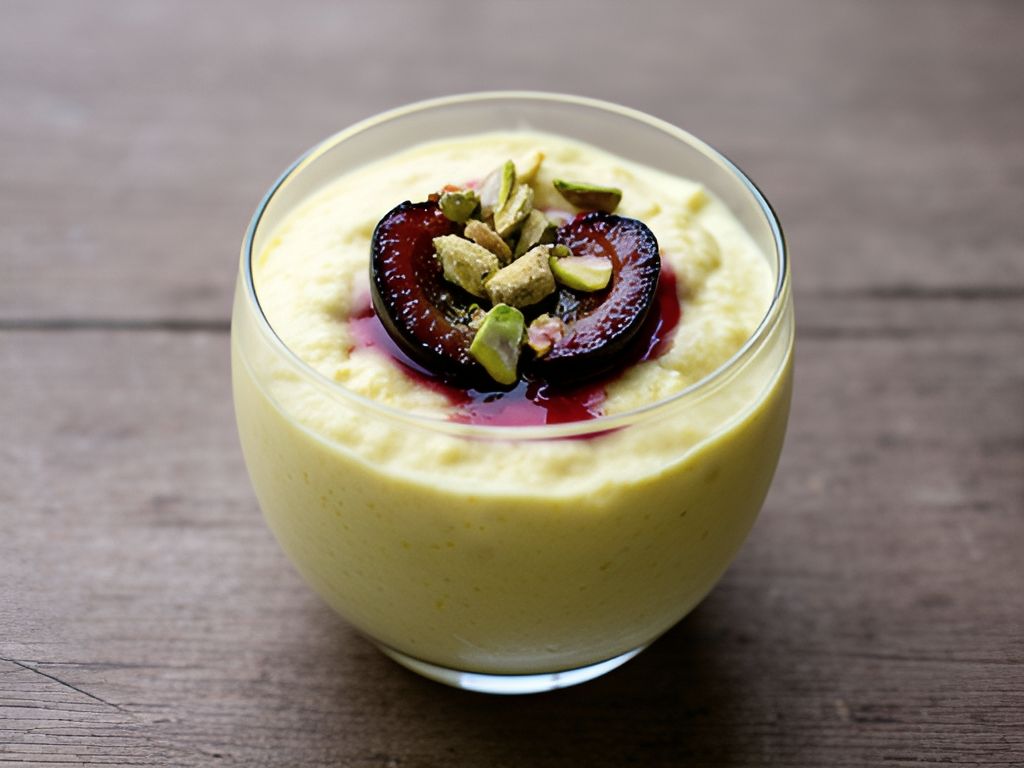
Saffron Shrikhand with Roasted Plums and Pistachio Praline
Gravity-hung yogurt sweetened at 20% of its own weight, saffron bloomed in warm milk, orange-scented plums and a dry-caramel praline that goes on at the table
Yield: 6 portions
Portion: ~80g shrikhand, 2 plum halves
Prep: 45m
Cook: 30m
Rest: 12h
Total: 13h 15m
Ingredients
Hung curd (start the night before)
- 700 g full-fat plain yogurt, live cultures, no milk powder, starch or gelatine; yields roughly 330-370g of curd
Shrikhand
- 0.2 g saffron threads, a generous pinch, crushed to a coarse powder
- 2 tbsp whole milk, warmed to about 60°C, for the saffron
- 72 g icing sugar, 20% of the actual curd weight; weigh the curd and recalculate, figure given for 360g
- 10 green cardamom pods, seeds only, freshly ground to a fine powder
- lemon juice, only if the finished shrikhand tastes flat rather than tangy, to taste(optional)
Roasted plums
- 10 plums, ripe, halved and stoned, skin on
- 40 g sugar, 25-30g if the plums are very sweet, up to 55g if sharp
- 2 tbsp water
- 1 strip of orange peel, about 5 cm x 1 cm, taken with a peeler, any white pith scraped off
Pistachio praline
- 100 g sugar, fine white (Kristallzucker)
- 80 g shelled unsalted pistachios, at room temperature, not from the fridge
- a pinch of flaky salt
Method
Hang the yogurt (8-12 hours ahead)
- 1
Line a sieve with doubled muslin or a clean thin tea towel and set it over a bowl deep enough that the sieve sits well clear of the whey. Add the 700 g yogurt, fold the cloth loosely over the top and refrigerate for 8-12 hours. Do not press or squeeze.
12h0-4°Csievemuslin or thin tea towelDo not substitute shop-bought Greek yogurt. It is strained by centrifuge or thickened with milk powder, and it goes grainy and chalky once sugar is whisked into it. Gravity-hung curd whisks glossy. Squeezing the cloth to speed things up pushes fat and fine protein into the whey and gives a drier, less rich curd.
Hung Curd (Gravity-Straining Yogurt)Tip: Keep the whey. It is acidic and lightly protein-rich, and it replaces some of the milk in a naan dough or goes into a lassi.
- 2
Tip the curd into a bowl and weigh it. Calculate the icing sugar at 20% of that weight: 72g for 360g of curd, 88g for 440g.
Yield varies with the yogurt and the drain time, so a fixed sugar weight will be wrong. 850g of yogurt hung overnight once gave 440g rather than the predicted 390g; at 75g of sugar that was only 17% and would have read flat. Twenty percent keeps it clearly tart, which is what lets it cut a rich meal instead of adding to it.
Hung Curd (Gravity-Straining Yogurt)
Shrikhand
- 3
Crush the 0.2 g saffron to a coarse powder between your fingers or with the back of a spoon; a pinch of the icing sugar gives it something to grind against. Warm the 2 tbsp milk to about 60°C, hot to the finger but nowhere near simmering, pour it over, cover and leave 15 minutes.
15m60°CCrushed threads release roughly twice what whole ones do. Boiling milk drives off safranal, the aroma you are paying for, so you get colour without scent. Colour appears in seconds; aroma takes the full fifteen minutes. Real saffron bleeds yellow-orange slowly; threads that dump red colour instantly are dyed.
Blooming Saffron - 4
While the saffron steeps, split the 10 cardamom pods, tip out the black seeds and grind them to a fine powder. Discard the husks.
5mPre-ground cardamom loses most of its volatile aromatics within weeks. This dessert has two aromatics and nowhere for a dull one to hide.
- 5
Whisk the curd with three quarters of the 72 g icing sugar until completely smooth and glossy, about 2 minutes. Taste, then add the rest of the sugar if it needs it. Whisk in the saffron milk, threads and all, and the ground cardamom.
5mIcing sugar only. Granulated sugar will not dissolve into cold curd and leaves it sandy. Stage the sugar because it can be added but not taken out. Loosen with milk only if the curd drained hard and is genuinely stiff, a tablespoon at a time; a softer curd needs nothing beyond the saffron milk.
Tip: With lactose-free yogurt, start at about 15% of the curd weight. Lactase has already split the lactose into glucose and galactose, both sweeter than lactose, so the base reads sweeter before you add anything.
- 6
Taste. It should be clearly tart with the saffron and cardamom sitting on top, not sweet. If it tastes flat rather than tangy, a small squeeze of lemon does more than more sugar. Cover and refrigerate for at least 4 hours.
It improves overnight as the cardamom infuses. A less-drained curd is slightly milder, which is where the lemon earns its place.
Roasted plums
- 7
Heat the oven to 200°C. Halve the 10 plums by cutting round the natural seam down to the stone, then twist the halves apart. Do not peel. Taste one raw and set the sugar: 40 g as written, 25-30g if very sweet, 55g if sharp.
10mThe skin holds the halves together and carries most of the colour; peeled plums collapse to mush. Clingstone plums will fight you: cut wedges off the stone instead and roast them 15 minutes rather than 20.
- 8
Arrange the halves cut side up in one layer in a baking dish. Scatter the sugar over, pour the 2 tbsp water into the base and tuck 1 strip of orange peel under a couple of plums so the peel sits submerged in the liquid. Roast 20 minutes, until slumped, wrinkled at the edges and bubbling but still holding their shape.
20m200°Cbaking dishCut side up so the sugar sits in the hollow, draws juice out and becomes the syrup. Peel in the liquid, never on top: above the liquid line it dries and scorches at 200°C, and burnt citrus peel is bitter. Underripe plums may want 25 minutes.
- 9
Cool, then lift out and discard the orange peel. Transfer the plums with every drop of syrup to a covered container and refrigerate. If the syrup is thin and watery, reduce it in a small pan for 2-3 minutes until it coats a spoon, pour it back over and cool again.
5mRemove the peel before storing. It has given everything it has after roasting, and left in overnight it turns the syrup harsh. A watery syrup runs straight off the shrikhand into the bottom of the glass.
Pistachio praline
- 10
Set up before the hob goes on: baking parchment on a flat tray right beside the hob, the 80 g pistachios and a pinch of flaky salt in a bowl next to it, a wooden spoon or heatproof spatula, and a light-coloured heavy-based pan (stainless steel, not non-stick, cast iron or dark enamel). Clear the counter between pan and tray.
5mlight-coloured heavy-based pantray lined with baking parchmentYou steer this entirely by colour, and in a dark pan you cannot see it. Once the sugar colours you have about fifteen seconds of decision time, the caramel sets in under a minute, and molten sugar at 170°C sticks to skin. Nothing can be fetched once it starts.
Dry Caramel and Nut Praline - 11
Spread the 100 g sugar in an even layer in the dry pan over medium heat. No water, no oil, and do not stir. After two or three minutes it melts to clear liquid at the edges while the centre is still crystals. Swirl the pan by the handle to even it out.
3mmediumStirring at this stage drags undissolved crystals into the melt and seeds crystallisation: the whole pan seizes into a lumpy white mass. Swirl, do not stir.
Dry Caramel and Nut Praline - 12
Once most of it is liquid, stir gently to fold in the remaining crystals. Watch it go clear, pale straw, gold, then amber, and take it off the heat at mid-amber, the colour of maple syrup or an old copper coin.
5mmediumOff at that colour, not after it: the pan carries it a shade further once it is off the burner. Too pale tastes only of sweetness. Too dark is bitter, and bitter caramel against saffron is unpleasant. If it seizes into lumps, keep it on the heat and be patient, they almost always remelt; never add water to molten sugar. If it goes dark brown and smells sharp, bin it and start again.
Dry Caramel and Nut Praline - 13
Tip in the pistachios and salt and stir fast for about 10 seconds to coat. Pour straight onto the parchment and spread thin with the back of the spoon, or lay a second sheet on top and press flat with your palm.
1mIt stiffens and grabs as the nuts go in; that is expected. Room-temperature nuts give you more working time than cold ones. Thin beats thick: it crushes more easily and gives better shards.
Dry Caramel and Nut Praline - 14
Leave 20-30 minutes until it snaps rather than bends. Break into pieces by hand, then crush coarsely: 5 seconds at speed 6 in the Thermomix, or a bag and a rolling pin. Into an airtight jar immediately.
30mStop at varied pieces, some fine and some lentil-sized. Reduced to sand it loses the point, which is contrast. Caramel is hygroscopic and goes tacky within a couple of hours in open air; sealed, it keeps a week.
Dry Caramel and Nut Praline
Assemble
- 15
Straight from the fridge, spoon the shrikhand into the glasses, about 80 g per glass, two thirds full, and tap the glass on the counter to level it. Two plum halves on top, cut side up, then a spoon of syrup over each, letting it run down the sides into the white.
3mServe cold. This course is the cold, acidic reset after a rich main, and letting it come to room temperature loses that. Do not stir the syrup in: the plum colour bleeding into the curd is most of the look. If the syrup has set firm in the fridge, stir a teaspoon of water through it.
Tip: The glasses can be filled with shrikhand an hour ahead and held in the fridge; plums and syrup go on at service.
- 16
Scatter the praline over at the table, or put the jar out and let people help themselves.
Praline on wet shrikhand softens within minutes, and it is the only crunch in the dish. Praline on early is soft praline.
Allergens
Dietary
Storage & Shelf Life
Refrigerated
Temperature: 0-4°C
Shelf life: 3 days
Freeze: Not recommended
Not reheated; every component is served cold or at room temperature. Keep the three components separate until service.
Plating
Small clear glasses so the layers show: white shrikhand two thirds up, two plum halves cut side up on top, syrup running down the inside of the glass into the curd. Praline scattered on in front of the guests.
Garnish: Pistachio praline, added at the table
Serve in: Small glasses, with long-handled spoons
Temperature: Cold, straight from the fridge
The Story Behind This Dish
“The dessert of a four-course Indian dinner for seven, after butter chicken. Shrikhand is the right close for that meal because it is essentially strained yogurt: cold, lactic and acidic, so it resets the palate instead of adding another layer of fat. The plums bring late-summer sweetness and the praline is the only crunch. Almost all of it is made ahead. The yogurt went into its cloth on Friday evening and hung overnight, the praline was made Saturday morning, and the plums roasted alongside the pumpkin soup. The real lesson came when the curd was weighed. The plan expected an over-drained 390g and had a fixed 75g of sugar plus milk to loosen it; the cloth gave 440g of softer curd, so the milk was dropped and the sugar was reset to 20% of the actual weight. That is how the recipe is written now: weigh the curd, then sweeten it.”
Wine pairing: The wine has to be sweeter than the dessert, which is easy because shrikhand is genuinely tart. A Valais Malvoisie flétrie has the apricot and saffron register built in. Amigne de Vétroz at three bees bookends a meal that started with the two-bee version. From across the border, an Alsace Pinot Gris Vendanges Tardives, or an Alto Adige Moscato Rosa to play directly with the plums.
Disclaimer: The information provided in this recipe, including preparation methods, storage guidelines, and shelf-life recommendations, is for general guidance only. We accept no responsibility for any foodborne illness or adverse effects resulting from the preparation, handling, storage, or consumption of food made using this recipe. Always follow safe food handling practices and consult official food safety guidelines.
Goes well with
Comments are not configured yet.